




Public Betting Trends in March Madness: What the Data Says (and How to Fade It)
Public betting activity reaches its peak during March Madness, reflecting the public betting trends it’s known for. The NCAA Tournament...

 0
0
Published Mar 18, 12:43pm ET by Ralitza Angelova
Last updated Mar 18, 12:43pm ET
Public betting activity reaches its peak during March Madness, reflecting the public betting trends it’s known for. The NCAA Tournament attracts an audience far beyond regular college basketball bettors, bringing in casual fans, office‑pool participants, and once‑a‑year wager makers. As more bettors enter the market at the same time, patterns in how the public approaches games become more visible, and sportsbooks often see consistent behavioral trends repeat year after year.
Understanding these patterns does not mean assuming the public is always wrong, or that fading the majority is a guaranteed strategy. Instead, it means recognizing how high‑volume betting influences lines, how sportsbooks account for this behavior, and how experienced bettors interpret public data without chasing it. Public betting trends can offer useful context, especially during a tournament marked by volatility, shifting expectations, and heavy national exposure.
Before examining how these trends appear and how they can be interpreted responsibly, it helps to establish what “public betting” means in the context of March Madness and why the tournament amplifies this behavior more than almost any other event.
What Is “Public Betting” in March Madness?
Public betting refers to wagering activity driven primarily by high‑volume recreational bettors rather than analytically focused or price‑sensitive bettors. During March Madness, this group expands significantly as casual fans, bracket participants, and infrequent bettors enter the market simultaneously. Their collective behavior creates visible patterns in both betting splits and market movement.
Public bettors typically gravitate toward outcomes that feel familiar or exciting. This often includes:
ChampioFavorites and popular programsnship winners
Teams with strong reputations, high seeds, or national recognition tend to attract a disproportionate share of public money, regardless of the underlying price.
Overs in widely viewed games
High‑profile matchups often attract greater public interest in overs, as casual bettors prefer fast scoring and offensive momentum.
Bracket‑driven decisions
Many public bettors wager on outcomes that align with their bracket predictions. If they have chosen a team to advance, they may also back them in the betting market, even when the line suggests uncertainty.
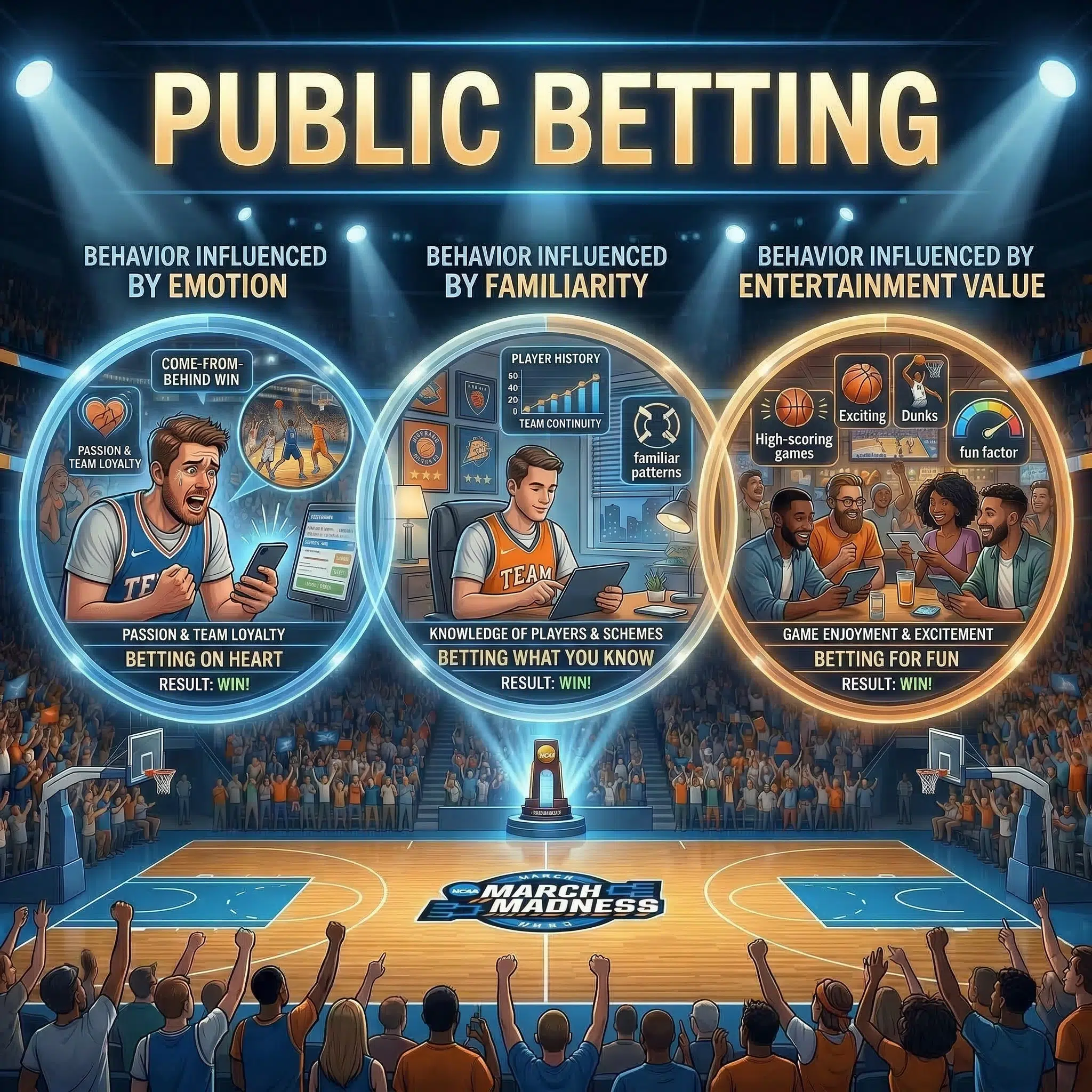
Public betting is not inherently incorrect or misguided. It simply represents high‑volume recreational behavior influenced by emotion, familiarity, and entertainment value. Understanding this baseline is the first step before examining why March Madness amplifies these tendencies so sharply.
Why Public Betting Is Amplified During March Madness
Public betting activity increases dramatically during March Madness because the NCAA Tournament reaches audiences far beyond traditional sports bettors. The combination of national attention, cultural relevance, and the bracket format creates an environment where recreational betting spikes, and, as a result, public sentiment becomes more visible in both betting splits and line movement.
National Exposure Drives Volume
The NCAA Tournament dominates sports coverage during March, with wall‑to‑wall broadcasting, highlight cycles, and widespread media narratives. This level of exposure brings casual fans into the market who may not typically place wagers during the regular season. With more eyes on the games, more recreational money enters the betting pool, amplifying the influence of public sentiment.
Office Pools and Bracket Culture
Millions of brackets are filled out each year, and these predictions often carry over into wagering decisions. Bettors who have chosen a team to advance in their bracket may be more likely to bet on that same team, regardless of the betting line. This connection between bracket picks and betting activity introduces biases unique to March Madness, shaping how the public allocates money across different matchups.
Casual Bettors Entering the Market
March Madness attracts a significant number of once‑a‑year or infrequent bettors who engage with the tournament for entertainment. These bettors often place wagers based on familiarity, excitement, or common narratives rather than price analysis. The influx of casual money increases the overall volume on popular sides and contributes to predictable public patterns.
Influence of Media Narratives and Recency Bias
Television segments, social media discussions, and highlight packages can lead bettors toward teams or storylines that feel compelling in the moment. This can create recency bias, where recent performance or memorable moments outweigh broader statistical context. During March Madness, such narratives spread widely and quickly, shaping public sentiment more than usual.
Together, these factors create an environment where public betting behavior becomes clearer and more concentrated than at any other point in the college basketball calendar.
Consistent Public Betting Trends Seen in March Madness
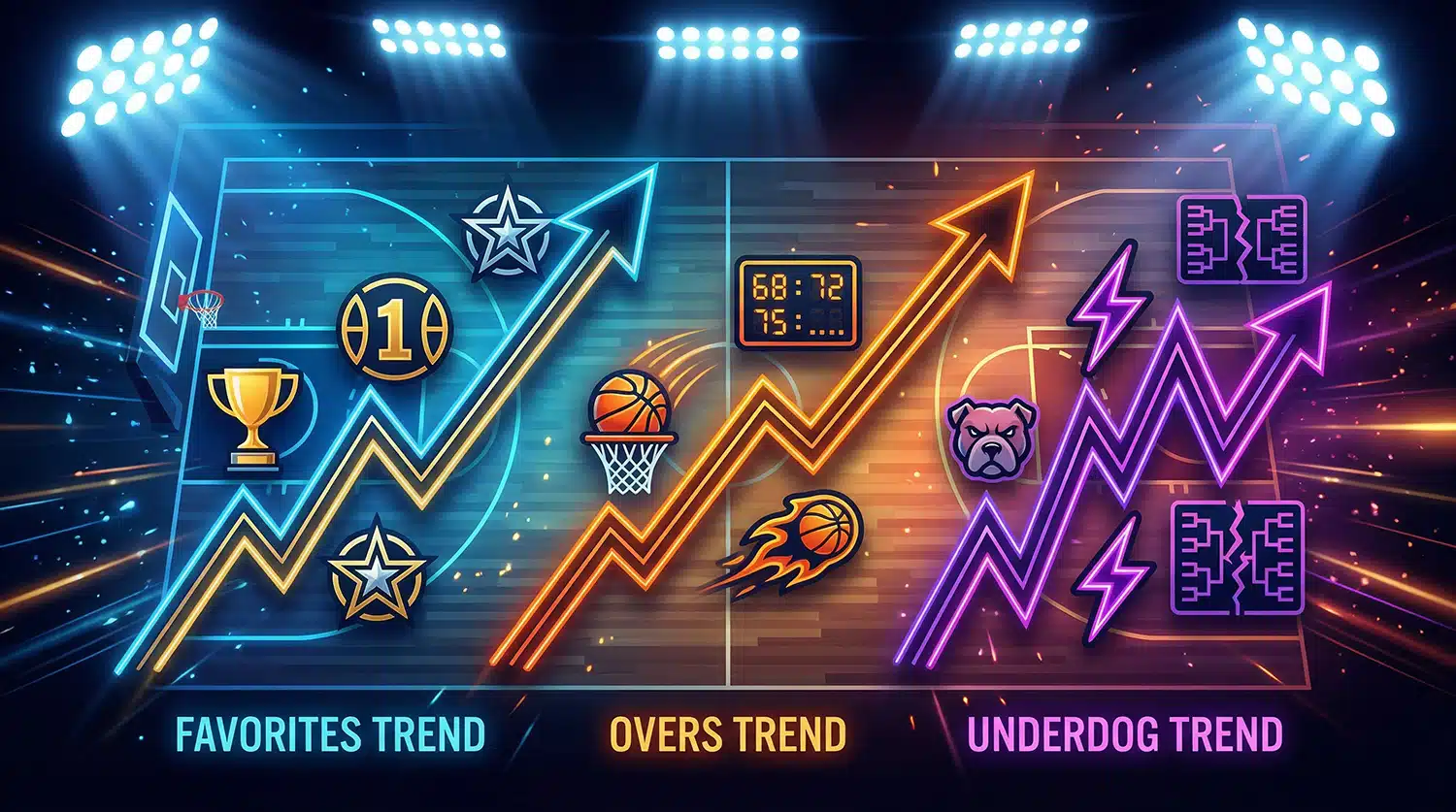
Public betting behaviour during March Madness tends to follow recognisable patterns that appear year after year. These trends do not guarantee outcomes, but they offer insight into how high‑volume recreational bettors typically allocate money across the tournament’s busiest periods. Understanding these patterns helps explain why certain betting splits become lopsided and how the market responds as lines adjust.
Heavy Action on Favourites
Public bettors frequently gravitate toward favourites, especially those with high seeds or strong national reputations. This tendency is influenced by brand familiarity, bracket expectations and overall confidence in teams that appear dominant on paper. As a result, favourites often attract more tickets and handle than statistical models might suggest. This is particularly noticeable in prime‑time games and early rounds when large mismatches are expected.
Overs in High‑Profile Games
High‑profile matchups, especially those featured in national broadcast windows, tend to draw significant overs interest. Casual bettors often prefer offensive narratives, fast scoring, and highlight‑friendly styles of play. This creates a pattern where overs receive heavy public action even when totals have already been adjusted upward. These trends do not indicate that overs are incorrect; they simply reflect widespread preferences that surface during heavily watched games.
Public Undervaluing Underdogs
Public bettors often show discomfort backing underdogs, particularly when the opposing team is well‑known or heavily covered in the media. This can lead to underdogs appearing undervalued in betting splits, even when spreads suggest a competitive matchup. The volatility of a single‑elimination tournament means that underdogs historically perform well, but public confidence tends to remain skewed toward favourites regardless of statistical variance.
Why These Trends Exist (Psychology & Market Behavior)
The public betting patterns that surface during March Madness are not random. They reflect predictable psychological tendencies and long‑standing market dynamics that become more pronounced when recreational volume surges. Understanding why these trends appear is essential for interpreting public data thoughtfully rather than reacting to it.
Recency Bias and Narrative Momentum
Casual bettors often rely on the most recent performance they’ve seen, giving disproportionate weight to highlight‑worthy wins, blowouts, or standout individual efforts. A team that exceeded expectations in its conference tournament, or a star player who delivered a memorable performance, can attract heavy public interest regardless of long‑term metrics. These narrative swings are especially common in a tournament where games are tightly clustered, and media coverage is constant.
Familiarity and Brand Comfort
Teams with strong national profiles, historic programs, top‑seeded favorites, or schools with major media visibility tend to attract public money because bettors feel more confident backing what they recognize. This comfort-driven decision‑making creates a tendency to overlook lesser‑known programs, even when statistical indicators suggest a narrower matchup. During March Madness, when fans are exposed to a flood of stories about big‑name teams, this effect intensifies.
The Entertainment‑First Mindset
For many March Madness participants, betting enhances the viewing experience. This leads to preferences for overs, high‑scoring teams, and popular favorites, making games more exciting to watch. While this doesn’t make the public “wrong,” it does mean their decisions are often influenced more by expected entertainment value than by price sensitivity or matchup analysis.
Bracket Anchoring
Because so many bettors create brackets before placing wagers, brackets act as a psychological anchor. If someone has chosen a team to advance, they may feel motivated to reinforce that choice with a wager, even when the line suggests volatility. This anchoring can create one‑sided public action, especially in early rounds where strong seeds appear on many brackets.
Market Bias and Line Visibility
Recreational bettors tend to gravitate toward lines that appear intuitive. A well‑known favorite laying a short number, or a high‑profile matchup with an appealing total, often draws immediate public attention. Sportsbooks anticipate these tendencies and may shade lines slightly toward popular sides, further reinforcing public activity.
How Sportsbooks React to Public Betting Trends

Sportsbooks understand the predictable public patterns that emerge during March Madness and adjust their pricing and risk management accordingly. Their goal is not to mislead bettors or force outcomes but to manage exposure in a market with unusually high recreational volume. Recognizing how books respond helps explain why lines move the way they do and why lopsided public splits do not automatically signal anything about the expected result.
Line Shading Toward Popular Sides
Oddsmakers often anticipate heavy public interest in certain favorites or in the over for high‑profile games. To prepare for this, they may open lines slightly toward the expected public side. This does not mean the line is incorrect. It simply reflects the expectation of disproportionate volume and allows books to manage risk before the market becomes crowded.
Managing Early‑Round Volatility
The first two rounds of the tournament produce an enormous amount of betting activity, especially on well‑known favorites. Books account for this by positioning spreads and totals to help limit liability. Slight adjustments early on allow them to handle the predictable surge of recreational wagers without creating exposure they cannot balance.
Balancing Ticket Count and Handle
Sportsbooks monitor both the number of bets and the amount of money wagered on each side. A favorite might receive most of the tickets while the opposing side receives a larger share of the total handle. During March Madness, this distinction becomes important because high ticket volume often represents casual activity rather than informed betting. Line movement typically reflects where respected money lands, not where the public volume sits.
What Fading the Public Actually Means
Fading the public is one of the most misunderstood concepts in sports betting, especially during March Madness. It does not mean betting automatically against the majority or assuming the public is consistently wrong. Instead, it refers to evaluating whether the price on a given side has shifted due to heavy recreational activity rather than the true market value. When used correctly, it is a lens for understanding pricing, not a strategy for picking outcomes.
It Is About Price, Not Opposing Popularity
The public can be on the right side of a game as often as anyone else. The value question comes from whether widespread public interest has pushed a line past a fair number. If a favorite becomes more expensive solely because of heavy public activity, that may create a better price on the other side. Fading the public is about identifying these situations, not reflexively betting against popular teams.
It Requires Context, Not Automatic Triggers
A lopsided betting split is not enough to justify a fade. Many March Madness games attract large public percentages simply because more casual bettors are involved. A meaningful fade consideration comes only when the market shows that the price has moved to accommodate that public volume and when sharp or well‑modeled indicators suggest the number has become inefficient.
Timing Plays a Significant Role
Public money arrives at predictable times, especially close to tip‑off. Early moves are more likely to reflect sharp influence, while late surges often come from casual bettors entering the market after filling out brackets or watching pre‑game coverage. Evaluating when and why a line has shifted is essential. Fading the public is most relevant when the movement appears disconnected from matchup data and more aligned with predictable public enthusiasm.
It Is Not a Standalone Strategy
No serious bettor relies on fading the public as a complete framework. It is one small piece of a larger process that involves analyzing matchup dynamics, injury updates, pace projections, roster profiles, and overall market movement. A disciplined bettor might note a heavy public side but will still rely on quantitative or analytical signals to make a decision.
Public Data Should Be Interpreted, Not Followed
Betting splits can offer useful context. They can help reveal where recreational volume is concentrated and how books might be balancing risk. But splits should never be viewed as predictions. They are indicators of behavior, not outcomes. Fading the public is simply one way to understand how behavior influences price, and it works only when applied with caution and a broader analytical framework.
Common Misinterpretations of Public Betting Data
Public betting data is often discussed in ways that create confusion or unrealistic expectations. March Madness magnifies this issue because betting volume increases sharply, and recreational interest becomes more visible. Understanding what public data does not represent is just as important as understanding what it does.
Public Percentage Does Not Predict Outcomes
A high percentage of tickets on one side does not mean that side is likely to lose. Betting splits reflect participation, not probability. During March Madness, popular teams naturally gather more wagers because more casual bettors are involved. Treating ticket percentages as predictive signals leads to false conclusions and encourages overreactions to normal behavior.
Contrarian Betting Is Not Automatically Profitable
Some bettors believe that consistently going against the public creates value. In reality, contrarian positions matter only when the price has shifted away from efficiency due to public influence. Simply finding a public majority and betting the other way has no inherent edge. Long-term success comes from evaluating the quality of the number, not the direction of crowd sentiment.
One Game Does Not Establish a Trend
Tournament results can swing dramatically, and a few high-profile outcomes often lead to exaggerated claims about the public being right or wrong. A favorite covering after heavy public support does not validate public betting, and an upset does not prove the public is unreliable. Trends should be viewed across multiple tournaments and seasons, not within isolated matchups.
Public Money Is Not the Same as Smart Money
Ticket count often reflects the volume of small wagers from casual bettors. Handle percentages can indicate where larger or more respected wagers have landed, but even these numbers must be interpreted carefully. A single large bet can distort handle splits without representing broad market sentiment. Assuming that handle percentages always reflect sharp positions is an oversimplification.
Line Movement Should Not Be Viewed in Isolation
A line moving toward or away from the public side does not automatically signal sharp influence or a meaningful market shift. Books adjust for a variety of reasons, including balancing exposure, anticipating public surges, or incorporating new information. Interpreting line movement requires context, not assumption. Reading too much into every tick can lead to inaccurate conclusions.
Using Public Betting Trends Responsibly During March Madness
Public betting trends can provide useful context during the NCAA Tournament, but they should be interpreted with caution and paired with a broader understanding of how the market functions. When used responsibly, these trends can help bettors understand where recreational volume is concentrated and how sportsbooks may be responding to it. They are not predictive tools on their own, but they can support a more informed view of the market.
Use Public Data as a Contextual Indicator
Public percentages can help illustrate where casual interest is strongest, especially in widely televised matchups. If a favorite is receiving a large share of the tickets, that information can explain why a line has moved or why certain numbers appear inflated. Treating public data as background context rather than a primary input helps maintain perspective.
Compare Public Sentiment With Actual Market Movement
A meaningful insight often comes from comparing betting splits to the line’s shift. If public support is heavy on one side but the line moves the other way, it may reflect sharper or more respected money influencing the market. Conversely, if the line moves toward the public side, it may indicate that bookmakers are adjusting to expected volume. Either scenario provides information about market behavior without guaranteeing any outcome.
Understand the Broader Tournament Structure
March Madness creates situations that differ from those in regular-season markets, including neutral-site games, rapid turnaround times, and unique travel conditions. Public data does not account for these factors. Using it responsibly means pairing it with matchup analysis, pace projections, injury notes, or rest considerations to form a complete picture.
Avoid Treating Trends as Predictive Signals
Historical tendencies illustrate how the public typically behaves, but they do not determine the results of individual games. In a single‑elimination tournament, volatility is extremely high, and outcomes can swing on small sequences. Using public trends responsibly means acknowledging that they describe behavior, not probabilities.
Incorporate Trends Into a Wider Research Process
Public betting information works best when combined with other tools, such as odds comparison, matchup evaluation, and an understanding of where respected money may have entered the market. It should complement a research framework rather than replace one. During March Madness, when pricing moves quickly and recreational volume spikes, this balanced approach becomes even more important.
For a complete breakdown of March Madness betting markets, odds, and tournament strategy, see our complete March Madness betting guide.



Popular Bets
Related Content


OSB Authors