
How March Madness Betting Odds Move During the Tournament (Public vs Sharp Money)
Author Tom McNeil Fact checked by Ralitza Angelova Updated on February 27, 2026 March Madness is one of the most...

 0
0
Published Feb 27, 9:10am ET by Tom McNeil

Last updated Feb 27, 9:10am ET

March Madness is one of the most popular betting events in the United States, as the games come thick and fast. The pace of the action and regularity of games mean there’s always a market to explore, whilst bettors will notice that the lines appear to move on a regular basis.
Line movement refers to a sportsbook adjusting the point spread, total, or moneyline in response to betting activity and the resulting liability. So why and how do they move during March Madness?
Why March Madness Odds Move Faster Than Any Other Event
There are a variety of reasons why betting lines move, but when it comes to March Madness, these are some of the most common reasons why they can move so quickly:
Volume of Games
This might seem obvious, but the sheer volume of games plays a major role in the movement of lines. This is especially true as the season progresses, with each game introducing new variables to consider. This can include injuries, momentum, future opponents, and more, and it’s one of the key reasons so many lines can move in an instant.
Influx of Casual Money
Due to the popularity of the tournament with casual fans, this increases the number of bettors. This trend has grown in recent years as fans shift from traditional brackets to sports betting. If the casual money is being wagered in one direction, then it’s only natural that the lines will move to counterbalance this.
National Attention and Betting Narratives
One of the most beautiful aspects of March Madness is the emotion that’s stirred, from players to pundits and fans. This can easily sway the nation toward a desired outcome, but it’s important to remember that betting lines are driven by algorithms, not emotion. The disconnect between the two can cause lines to move in alternate directions.
Rapid Market Correction Windows
Rather than waiting to see where the money is being wagered, sportsbooks will adjust lines rapidly based on new information. This can include injuries or suspensions, anomalies in style matchups with future opponents, and more.
What Actually Causes Betting Lines to Move
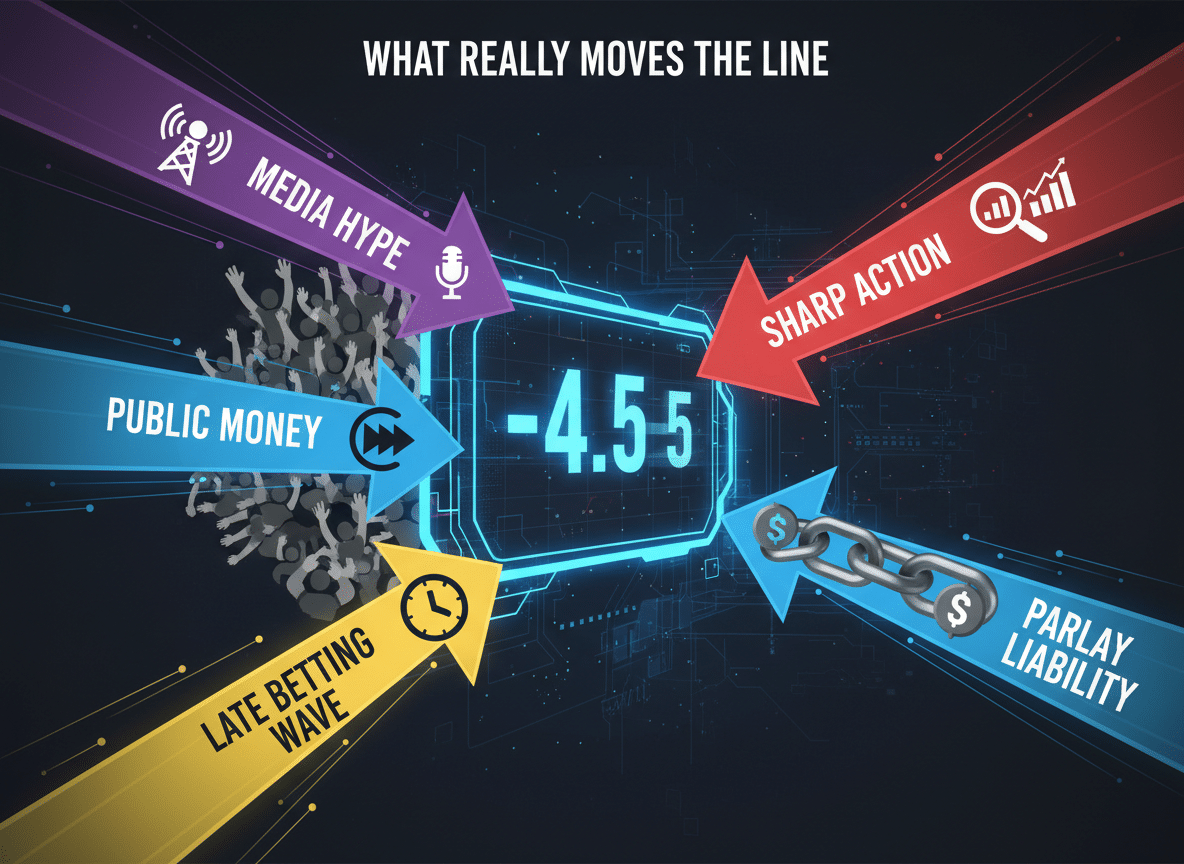
Most bettors assume lines move because “everyone is betting one side.” In reality, sportsbooks don’t respond to the number of bets; they respond to where the money comes from and how that money affects their overall risk position.
Line movement is driven by a few core factors:
Beginner bettors don’t need to memorize odds; the key is understanding what kind of bet fits your comfort level.
Betting Volume vs. Bet Size

Sportsbooks don’t weigh all wagers equally. A line isn’t going to move because a wave of $5 or $20 bets happens to come in at the same time. Books move numbers when the size of the wagers creates meaningful exposure. During March Madness, this difference becomes obvious.
A thousand casual bets might barely register, but a few large wagers placed early can move an opening line immediately. It’s not “how many people are betting.” It’s how much liability each wager creates.
Risk Management by Sportsbooks
Books aren’t predicting outcomes; they’re balancing financial risk. Every line is shaped around the book’s appetite for exposure, and every adjustment is designed to keep that exposure within an acceptable range. If early wagers push the book toward an uncomfortable imbalance, the line moves to encourage action on the opposite side.
This is especially true during March Madness, when games overlap, and the market evolves by the hour. Books adjust aggressively because they don’t want inefficient numbers lingering in a fast-moving tournament environment.
Liability Across Brackets and Parlays
March Madness is unique because individual games don’t exist in isolation. They sit inside:
- brackets
- multi-leg parlays
- futures positions
- same-game combinations
When money stacks up across multiple interconnected markets, a single game can carry far more liability than its standalone handle suggests. Books sometimes move lines not because of game-specific action, but because that result would magnify exposure across entire sections of their portfolio.
In short:
Lines move because of risk, not popularity. Books are managing the entire tournament at once, not a single game in a vacuum.
The Role of Public Money in March Madness Odds
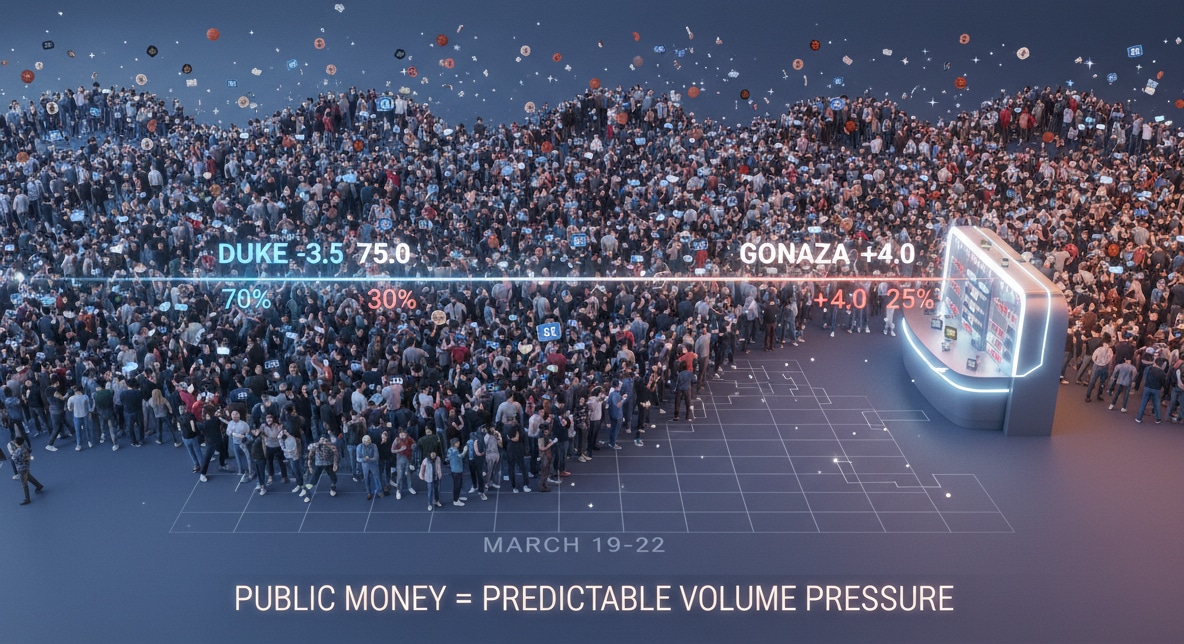
Public money plays a predictable, almost rhythmic role in how March Madness lines move. It doesn’t carry the precision or intent of sharp action, but the volume and timing of public wagers create market patterns that appear every single year.
Favorites and Popular Teams
Public bettors tend to gravitate toward what they recognize: brand‑name programs, high seeds, recent winners, and teams with national media attention. This isn’t a flaw in their approach; it’s simply the natural consequence of familiarity.
When enough casual bettors cluster on the same side, sportsbooks may shade the number slightly to stay ahead of the anticipated volume.
This is why the most visible programs often appear a half‑point to a point pricier than their underlying metrics suggest. The line isn’t “wrong.” It’s accounting for the waves of attention those teams reliably generate.
Game‑Day Betting Surges
March Madness compresses public action into short bursts. Unlike regular‑season basketball, most tournament games see the majority of their handle come in the final hours before tip‑off. As bettors check their brackets, watch studio coverage, or scroll social feeds, their wagers tend to stack in the same direction, usually toward the favorite or whichever storyline is dominating the day.
These game‑day surges don’t reshape a market the way sharp buy‑ins do, but they influence how books manage late liability. If a number moves in the hour before tip, it’s often just a sportsbook balancing risk as the public piles in, not reacting to new information.
Overs, Parlays, and Primetime Games
Public preferences extend beyond sides. During March Madness, the public leans toward:
- Overs, especially in fast‑paced matchups
- Parlays and same‑game parlays, which magnify exposure
- Primetime games, where viewership and casual engagement spike
Books know these trends are coming, and they often nudge lines pre‑emptively to keep their liability in check. None of these signals a hidden angle or insider opinion; it’s simply the market responding to predictable patterns of recreational wagering.
How Sharp Money Influences March Madness Lines
Sharp money plays a very different role in March Madness than public action. It arrives earlier, carries more weight per wager, and often forces the market to settle into its true number long before casual bettors ever see the line.
Understanding this isn’t about adopting sharp strategies; it’s about recognizing how their behavior shapes the odds everyone else interacts with.
Early Market Action
Sharp bettors are most active when lines first open. This is the stage at which oddsmakers test their numbers, and limits are intentionally kept low. Early wagers from respected accounts are a signal more than volume; they tell the book whether its opening figure is in the right neighborhood.
During March Madness, this feedback loop becomes even tighter. With dozens of games priced in a short window, books rely heavily on early sharp money to refine their openers. A small correction on a Sunday night might not look dramatic to the casual eye, but in practice, it reflects the most efficient part of the market doing its work.
Smaller Number of Bets, Larger Impact
Sharp action doesn’t come in by the thousands. It arrives as a handful of wagers at limits high enough to matter. Books don’t need a tidal wave of tickets to react; they need one wager from the right bettor at the right moment.
This is why sharp influence is often visible long before public money appears on the board. A single sharp position may move an opener a half‑point or more, not because the book fears the bettor, but because the wager highlights where the number is misaligned with reality. The public rarely sees this in real time, but by the time the majority arrives, the market has already been shaped by those early strikes.
Why Sharp Money Arrives Before the Public
Sharp bettors operate on information cycles that look nothing like the casual market. They price matchups in advance, monitor efficiency metrics continuously, and know exactly how far their money will move a line at different books.
When the tournament bracket is released, they already have a framework for where numbers should land.
Because of that preparation, sharp money tends to hit the board the moment limits open. Public money, by contrast, builds gradually as game day approaches; after bracket chatter, broadcast discussion, and social narratives kick in.
The result is a market where the earliest movement reflects informed correction, and the later movement often reflects volume management. Neither is inherently “right” or “wrong.” They simply represent different forces acting on the same line at different times.
Timing Matters: When Odds Move the Most
Even though March Madness lines can move at any time, the type of movement and the reason behind it depend heavily on when it occurs. The tournament compresses the entire life cycle of a betting market into a narrow window, and each phase has its own dynamics.
This section breaks down those phases so readers understand why a line moves when it does, rather than treating all movement as equal.
Opening Lines
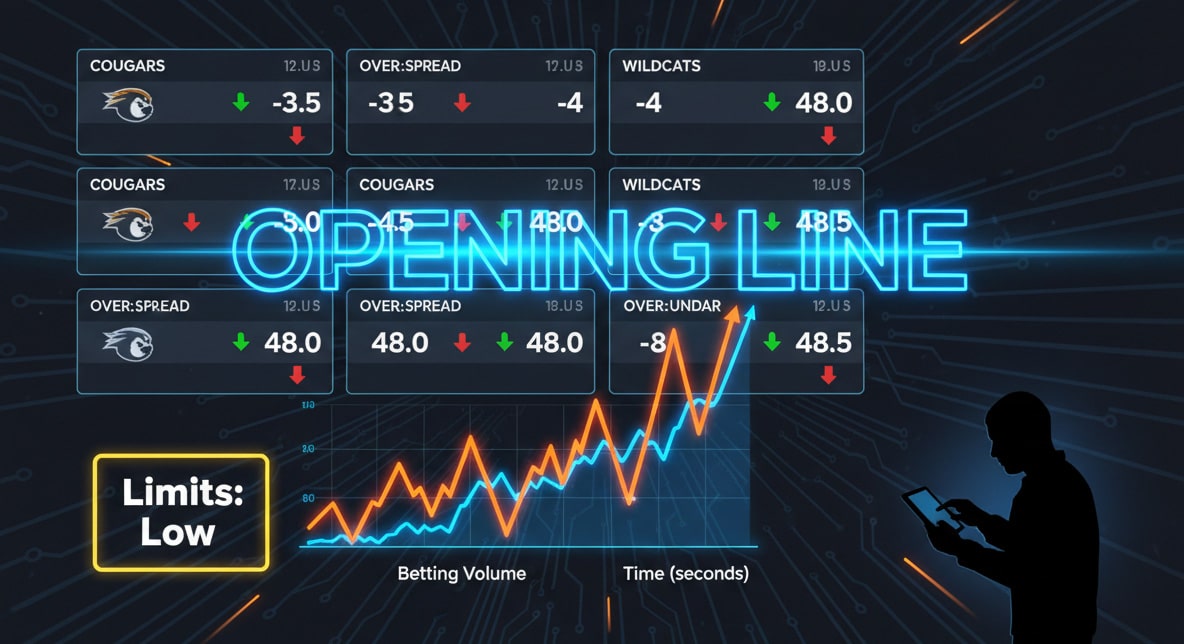
Opening lines are the purest form of the market. They reflect the bookmaker’s initial number, a blend of power ratings, matchup data, and internal modeling, before the public or broadcasters have had a chance to create narratives around the game.
A few key characteristics define this stage:
Early Adjustments Happen Quickly
When a book posts its opener, limits are intentionally lower. Sportsbooks understand that the most informed bettors are waiting for this exact moment. Because of that, they expect and invite early, sharp action. An opener might move a half‑point or more within minutes, not because the book is worried about the bet itself, but because the wager reveals where their number is off.
This is the market at its most efficient, even if it appears most volatile.
Why Limits Are Lower
Lower limits reduce the sportsbook’s risk while they gather data. Sharp bettors aren’t trying to “beat” the book here; they’re providing feedback. If early action comes in aggressively on one side, the book adjusts and gradually raises limits once the number stabilizes.
By the time most public bettors see the line, it may already have shifted from its opener, meaning the market has already absorbed the most informed opinions.
Pre‑Game & Tip‑Off
This is when the majority of bettors enter the market, and the nature of the movement changes entirely.
Public Money Floods the Board
The hours before tip‑off bring the largest volume of wagers, especially during March Madness when multiple games share the same time windows. The public clusters around favorites, well‑known programs, and teams that benefited from recent media coverage or standout highlight moments.
None of this reflects inefficiency; it reflects predictable human behavior. Sportsbooks know this and adjust accordingly.
Books Balance Risk Across the Tournament
Late public money doesn’t “correct” the line; it reshapes the book’s financial position. If a favorite is pulling 75% of the tickets in the final hour, a half‑point move isn’t a signal of new information;, it’s a signal of liability control.
This distinction matters between sharp movement early and public‑driven balancing late. Both move the number, but for fundamentally different reasons.
Live Betting Movement
Once the game begins, the market shifts into its fastest, most reactive state.
Faster Adjustments Become the Norm
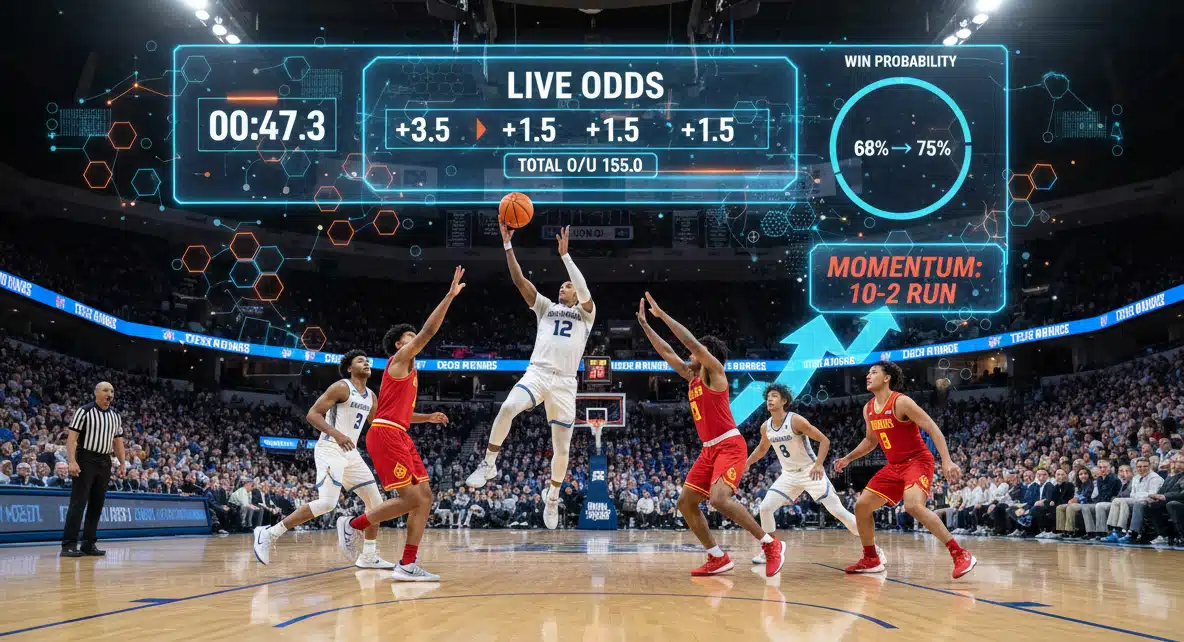
Live odds are powered by algorithms that update based on:
- scoring runs
- pace changes
- injury events
- foul trouble
- win‑probability shifts
- time remaining
These changes can appear dramatic, especially during March Madness, where momentum swings are common. But it’s important to distinguish volatility from inefficiency. A 10–2 run might move a live spread multiple points, but that doesn’t mean the new line is “wrong”; it means the game state has fundamentally changed.
Momentum vs. Pricing Reality
Public bettors often overreact to momentum in live markets. Books, meanwhile, anchor pricing to probability models that stabilize over time. This creates brief moments where public sentiment and algorithmic reality divide sharply, but those gaps close quickly because live markets are designed for speed, not exploration.
In live wagering, corrections happen in seconds, not hours.
Common Misconceptions About Line Movement
Line movement is one of the most misunderstood aspects of March Madness betting. Even experienced bettors often misinterpret why a number shifts, what the timing means, or whether a move carries any real informational value. Clearing up these misconceptions is essential because faulty assumptions lead to bad interpretations, not bad bets, just bad readings of the market.
Below are the myths that appear every year, along with the realities behind them.
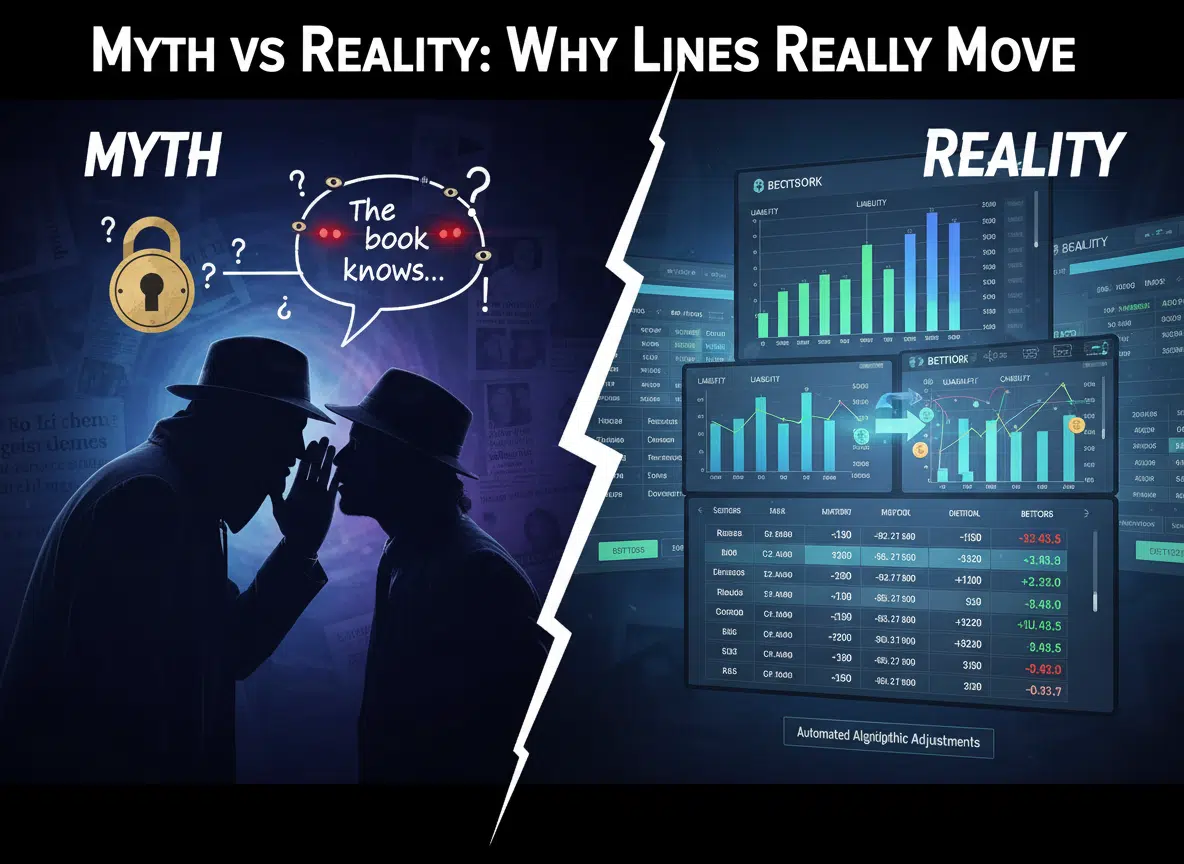
“The line moved, so the book must know something.”
This is one of the oldest and most persistent myths in all of sports betting.
Books don’t move lines because they know a secret.
They move lines because their risk profile changed.
A movement might reflect:
- early sharp action
- public surges
- liability from parlays and brackets
- correlated exposure across the tournament
- simple testing of where the market will settle
None of this suggests inside information. Sportsbooks don’t move a line because they suddenly believe a team is more or less likely to win; they move it because their financial position shifted.
Books react to money, not hidden knowledge.
If anything, the market itself is often the signal, not the sportsbook.
“All line movement is sharp money.”
Not even close. Sharp movement is very real and very influential, but it represents only one slice of line action.
During March Madness in particular, a significant portion of line movement is driven by:
- public game‑day clustering
- predictable enthusiasm for favorites
- parlay liability
- national media momentum
- timing windows where casual bettors overwhelm the handle
Books adjust to all of this, not just sharp positions.
Sharp money typically moves lines early.
Public money typically moves lines late.
If a number jumps 30 minutes before tip‑off, it’s rarely a case of sharp bettors “swooping in.” More often, it’s a tidal wave of small wagers forcing the book to rebalance.
This is one of the most overstated assumptions in sports betting analysis.
Late line movement can be meaningful, but only within context.
Sometimes, late movement reflects:
- sharp buyback
- market correction based on new information
- liability management from public surges
- automated adjustments triggered by overwhelming volume
But sometimes, late movement is simply the book finishing its balancing act. When 90% of bets come in the last few hours, as is common in March Madness, late moves often reflect volume, not opinion.
A closing‑line move isn’t inherently smart or predictive.
It’s just the final state of a market shaped by multiple forces.
Some moves are meaningful.
Some are mechanical.
Some is noise.
Understanding the difference takes experience and context, not the clock.
Why These Misconceptions Matter
Misreading line movement doesn’t just lead to mistaken assumptions; it creates unnecessary narratives. Many bettors chase signals that aren’t signals at all, or attribute meaning to moves that were nothing more than routine exposure management. By understanding what line movement isn’t, readers are better equipped to understand what it is: a reflection of market behavior, book liability, and timing, not mystery or hidden knowledge.
How Bettors Can Read Odds Movement Without Chasing It
Understanding odds movement isn’t about reacting to every shift or trying to “follow” the market. It’s about recognizing what the market is telling you, and just as importantly, what it isn’t telling you. March Madness moves fast, and bettors who learn to interpret movement calmly tend to develop a clearer view of the tournament’s broader market rhythm. This section focuses on awareness, not tactics. Think of it as a framework for reading the market without getting swept into it.
Understanding Context
A line move only makes sense when you understand why it moved.
A half‑point shift on an opening number means something very different than a half‑point shift 20 minutes before tip. The market forces are different, the type of money involved is different, and the sportsbook’s motivations are different.
When looking at any movement, it helps to consider:
- When the move happened
- How quickly the move occurred
- What else was happening in the market at that moment
- Whether other books moved in sync or held steady
A number shifting at 7 a.m. ET on a Monday reflects early‑market correction, usually sharp‑driven.
A number shifting at 6:45 p.m. ET before a primetime tip reflects public liability management. The movement itself isn’t the signal; the context is.
Avoiding Emotional Reactions
March Madness compresses emotions. Games come in waves, betting handles spike instantly, and social media often amplifies every shift as if it’s a breaking development.
The worst outcome isn’t misreading a move; it’s reacting emotionally to one.
A few common triggers during the tournament:
- The number moves against what you expected
- A favorite becomes more expensive late in the day
- A total jumps after an injury report
- A broadcast narrative sends public money flying in one direction
None of these requires a reaction. They simply reflect normal market mechanics in a high‑volume, high‑interest event. A calm interpretation is far more valuable than a rapid response. The market moves because the tournament is chaotic; emotions do not improve clarity.
Knowing When Not to Bet
One of the most overlooked parts of reading line movement is recognizing when the best move is no move at all.
Sometimes a line moves for reasons unrelated to the number’s quality —public enthusiasm, bracket clustering, parlay pressure, or even automated corrections. When movement feels like noise rather than a signal, the most disciplined bettors simply step back.
A few situations where restraint often makes sense:
- When the line has already moved significantly, and the reason is unclear
- When you’re unsure whether the move reflects sharp action or public volume
- When every major book is moving differently, suggesting instability rather than consensus
- When the market is reacting to an emotional moment rather than a change in underlying probability
Being able to avoid betting, observing rather than participating, is a key distinction between understanding the market and chasing it.
Line movement is a tool for awareness, not a scoreboard to keep up with.
Using Odds Movement to Make Better Betting Decisions
Reading line movement isn’t about copying what the market does. It’s about understanding why the market behaves the way it does, and using that understanding to make calmer, more informed decisions as the tournament unfolds. March Madness is unique because all three components, timing, comparison, and market rhythm, compress into short windows. The goal here is not to prescribe a strategy but to explain how an informed reader can interpret the board more clearly.
Line Comparison: Seeing the Market as a Whole
One of the simplest ways to understand line movement is to compare numbers across multiple books. A single sportsbook might move for reasons unique to its own exposure, but when several major operators shift in the same direction, it usually reflects a broader consensus.
A bettor doesn’t need to act on these differences; simply noting them can clarify whether a movement is:
- isolated to one book
- the result of public weighting
- a true market‑wide correction
- noise driven by timing or liability
Line comparison is less about “finding a better number” and more about seeing how the entire market values
Timing Awareness: Recognizing the Market Cycle
Odds movement during March Madness follows a repeatable pattern every year. Understanding that pattern makes the board feel less chaotic and more structured.
In most cases:
Early movement reflects correction.
Mid‑week movement reflects settling.
Pre‑tip movement reflects volume.
Live movement reflects game state.
No part of this cycle guarantees a better or worse number. What matters is recognizing what type of movement you’re seeing, so it isn’t misinterpreted as something more meaningful than it is.
A shift at midnight on a Sunday and a shift at 6 p.m. on a Thursday might look identical on the odds screen, but their roots and implications are completely different.
Market Behavior During March Madness
Every tournament develops its own rhythm. Certain rounds attract more public enthusiasm, certain time slots attract higher volume, and certain games create spillover into adjacent markets, such as parlays and futures. Recognizing these patterns helps bettors determine when movement is likely and when the board is simply stabilizing.
Some recurring behaviors include:
- Favorites becoming more expensive as tip‑off approaches
- totals fluctuating with pace‑driven matchups
- heavy public clustering during primetime windows
- quick adjustments following injuries or efficiency‑metric shifts
- lines settling into tighter ranges once the early sharp influence is absorbed
None of these are signals in isolation. They’re part of the tournament’s market ecosystem — predictable, observable, and useful for understanding how and why numbers shift as quickly as they do.
Where This Fits in the Bigger Picture
Reading line movement is not about chasing indicators. It’s about developing a calm, structured understanding of the market so that the speed of March Madness feels coherent rather than chaotic. When bettors can see the underlying forces, early correction, late volume, public clustering, and cross‑market liability, the board becomes easier to interpret and much harder to misread.
For live odds, line movement tracking, and bet timing insights, see our complete March Madness betting guide.



Popular Bets
Related Content


OSB Authors





Further Reading



Guides 12 months ago
Best VPNs for Online Gambling (2026 Guide)
Guides 1 year ago
The Biggest Underdog Sports Betting Events